

Brake fluid is a fundamental component of the hydraulic braking system. It transmits the force exerted on the brake lever to the caliper pistons and also prevents the formation of water droplets in the circuit, thus preventing component corrosion.

Due to its importance to user safety, the United States Department of Transportation (DOT) required brake fluid manufacturers to meet certain safety requirements when manufacturing their brake fluids. These requirements gave rise to the DOT classifications (DOT 3, DOT 4, DOT 5, and DOT 5.1), all of which specify the composition of fluids according to their dry boiling point, wet boiling point, viscosity, and the fluid base, typically derived from polyglycols, but also silicone bases and even mineral oils:
- DOT 3 : Glycol-based, used in conventional brakes. It has a dry boiling point of 205°C, a wet boiling point of 140°C, and a viscosity of 1500 cSt. It can be mixed with DOT 4 and DOT 5.1 fluids, although this is not recommended.
- DOT 4 : Glycol-based, used in ABS and conventional brakes. It has a dry boiling point of 230°C, a wet boiling point of 155°C, and a viscosity of 1800 cSt. It can be mixed with DOT 3 and DOT 5.1 fluids, although this is not recommended.
- DOT 5 : Silicone-based, used in high-performance brakes without ABS. It has a dry boiling point of 260°C, a wet boiling point of 185°C, and a viscosity of 900 cSt. It cannot be mixed with DOT 3, DOT 4, and DOT 5.1 fluids.
- DOT 5.1 : Glycol-based, used in high-performance brakes with or without ABS. It has a dry boiling point of 260°C, a wet boiling point of 180°C, and a viscosity of 900 cSt. It can be mixed with DOT 3 and DOT 4 fluids, although this is not recommended.

How to choose one type or another?
It's important to remember that a braking system generates a lot of heat, so the boiling point of brake fluid (the higher the better) is a key factor to consider.
Another important fact is that glycol-based fluids (DOT 4, DOT 5 and DOT 5.1) are hygroscopic (they absorb moisture) and, therefore, tend to deteriorate over time and must be changed every 2 or 3 years, while silicone-based fluids (DOT 5) are hydrophobic (they repel moisture), so they withstand the passage of time better and do not damage the rubber seals.
To determine the condition of the brake fluid, we can use a specific brake moisture tester .
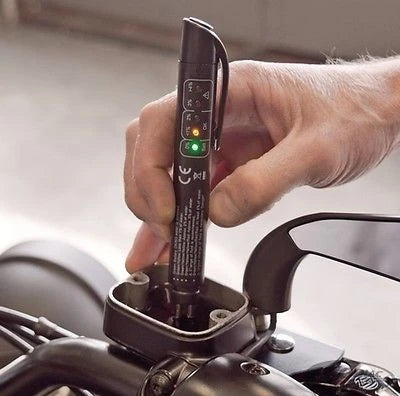
In any case, it is the brake manufacturer who is responsible for specifying the type of brake fluid to be used in their product, so the best brake fluid will always be the one recommended by the motorcycle or braking system manufacturer.
Frank Burguera
#harleymechanics
0 comments