

Transmission oil must protect the gears and clutch plates while facilitating smooth and precise gear shifting. We'll explain how oil performs these functions and what qualities are essential in its formulation.
The transmission and gearbox
The function of the gearbox and transmission seems simple: to transmit engine power to the rear wheel. But, to fulfill this task, transmissions are equipped with complex systems of shift gears, multi-disc clutches, and various actuators, located in increasingly smaller and more compact compartments, with multiple oil passages of very small diameter. The transmission oil must be able to lubricate all these gears with sufficient volume, while maintaining constant fluidity to properly pass through all the passages. The oil is forced to withstand high loads of trapped torque between the gears and dissipate large amounts of heat, the main enemy of transmission oil. All this without forgetting its main function: protecting the surfaces from direct contact with each other, creating a protective film.
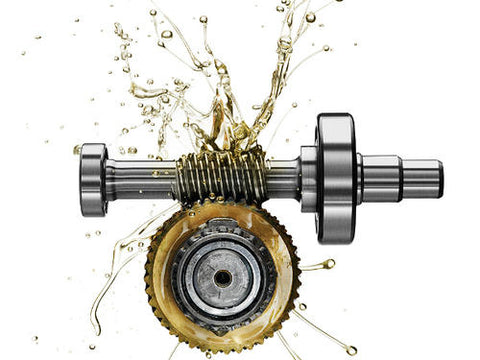
To recap, we can define the main functions of transmission oil as:
- It works like a hydraulic fluid: it is used in modern engines primarily to activate chain tensioners, so it must be able to withstand this compressive stress.
- Provides optimal friction: Clutch discs require a very constant and precise level of friction to engage and disengage properly.
- Protects gears from wear: It helps cushion heavy loads between their teeth by creating a protective film that prevents metal-on-metal erosion.
- Combating heat: Motorcycle transmissions generate a large amount of heat, which the oil dissipates. This heat causes oil oxidation.
Oil change
Both excessive heat (oxidation) and high pressure break the oil's molecular bonds and continually degrade it, which is why it needs to be changed every few miles. At the same time, the oil becomes loaded with metallic microparticles, which it carries along with it, and it also absorbs ambient moisture, which infiltrates the transmission.
When the oil level is degraded or very low, it can cause irregularities and difficulty shifting gears, indicating that something is wrong. It's important to change the oil before this happens.

What is the best transmission oil?
Although it may seem complex, the answer to this question is very simple: the best oil is the right oil.
Depending on the segment and motorcycle model, transmissions can be automatic or manual, integrated with the engine or separate from it, and even have independent transmission and primary transmission, as in the Harley-Davidson Big Twin models.
These differences mean that a specific oil must be used for each case, preferably synthetic and meeting or exceeding the manufacturer's specifications in terms of properties and additives. Likewise, it is always essential to adhere to the recommended oil change intervals, and even reduce them if the vehicle is used in extreme conditions (heat, sand, racing, heavily loaded luggage, etc.).
Frank Burguera
Looking for a good transmission oil for your motorcycle? Check out our selection of the best motorcycle oils at this link .
#harleymechanics
0 comments